Community Concept Paper.
A first look at what we’re building, and where we want your input.
Version 1 | Fall 2026
Why We’re Doing This.
Across Omaha, neighbors, organizers, faith leaders, business owners, and nonprofit staff are working every day to make their communities better. Many are doing it without easy access to the data that could back up what they already know. The information is out there, but it’s scattered across dozens of websites, and making sense of it takes time and training that most people don’t have.
That gap has real consequences. The communities that need good local information most are often the ones least likely to get it. We saw this during COVID-19, when the communities hit hardest were also the ones with the least access to clear, local information about their own health. When people can’t see what’s happening in their own communities, it’s harder to make the case for change, harder to plan ahead, and harder to tell the story of what their communities are already achieving.
This fall, we interviewed 8 leaders from nonprofits and community organizations across Omaha, and we heard the same things again and again. Data is hard to find. It’s hard to verify. It’s rarely specific enough to speak to a single community. And too often, it paints communities as “at risk,” “struggling,” or “in need,” while leaving out everything that’s already working. The people we spoke with want data that reflects the strengths in their communities and helps them build on what’s already there.
That’s why we started Omaha Data Commons: to make local data free, digestible, and shaped by the people it’s about, so more communities can use it to tell their own stories, advocate for what they need, and organize together. Omaha Data Commons was founded by Dr. Taylor Goulbourne, an Omaha native with a background in public health and health communication. She has spent her career helping organizations use data to understand their work and tell their stories. Her research also shows that access to clear, local information shapes a community’s health.
What We’re Building.
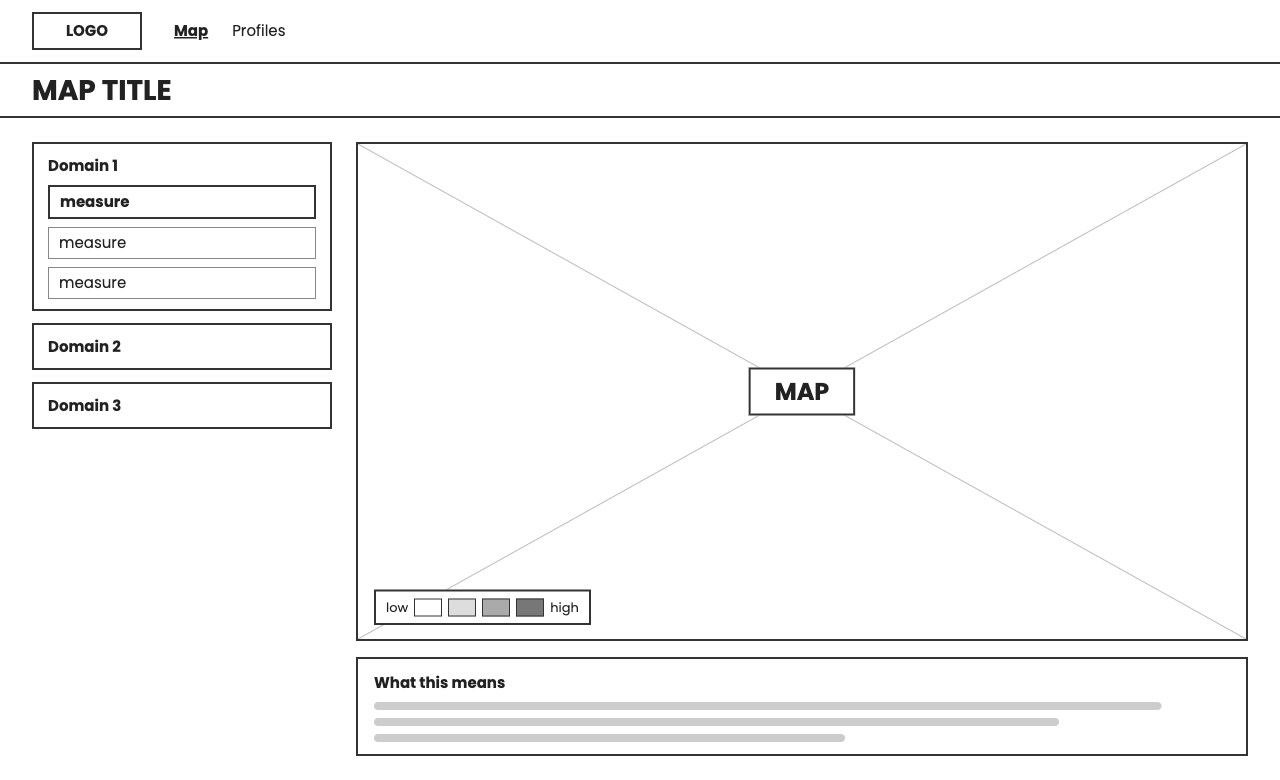
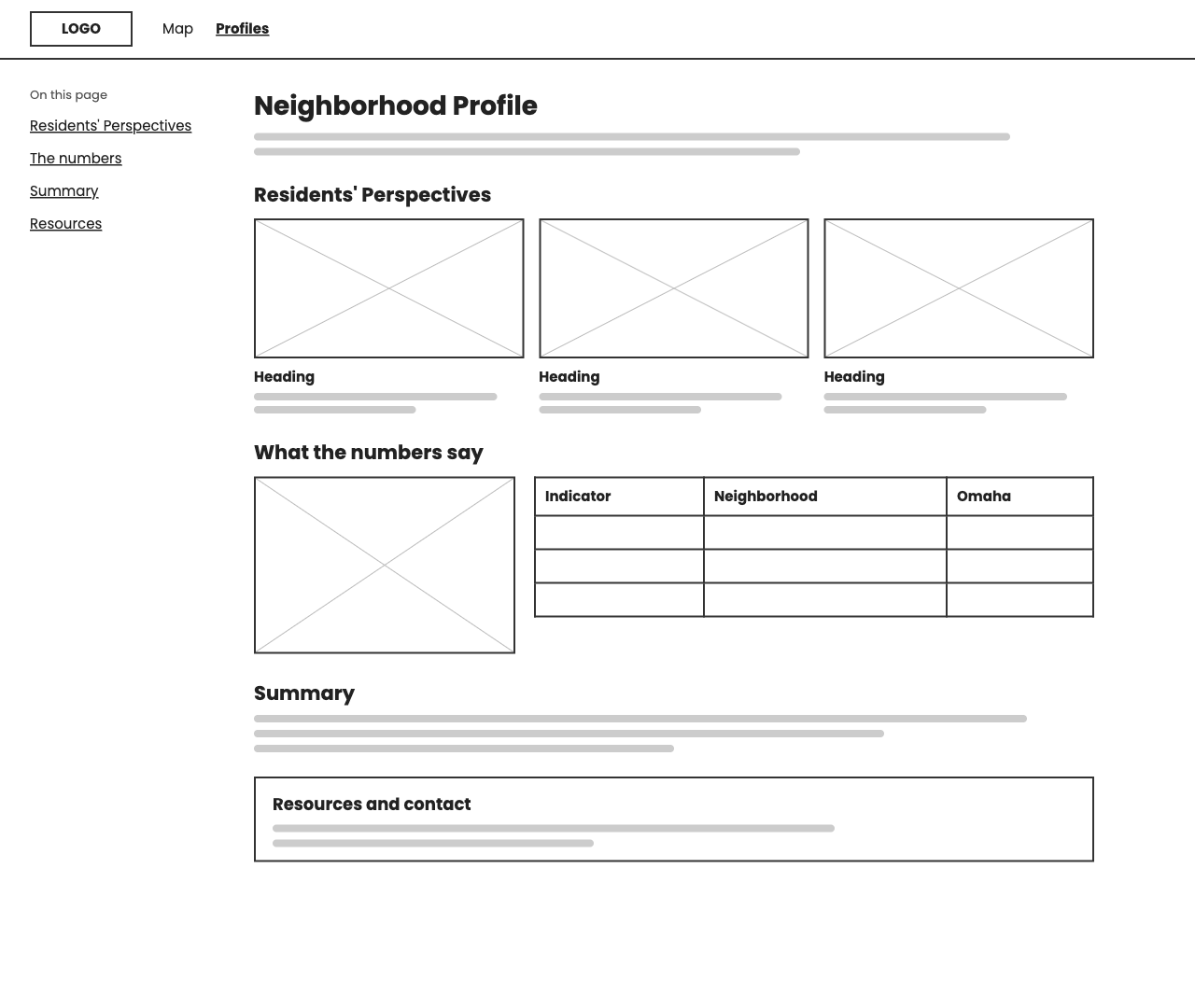
Low-fidelity mockups of the map and neighborhood profile, with placeholder content. Inspired by the City Health Dashboard from NYU Langone Health and the community briefs from the Drexel Urban Health Collaborative.
Omaha Data Commons is on a mission to turn community data into a tool for storytelling, advocacy, and collective action in Omaha. It brings together a free interactive map, neighborhood profiles, and support for putting both to use, for the neighbors, organizers, faith leaders, business owners, and nonprofit staff working to make their communities better. Built with community every step of the way.
At its core is the map: a free interactive view of Omaha that brings publicly available health and well-being data together in digestible terms. As the mockup shows, the map shades Omaha from low to high for each measure. It also includes a “What this means” box to explain each measure. Measures are grouped into domains, which are areas tied to the social determinants of health. At launch, the map will draw on two public sources: the U.S. Census Bureau’s American Community Survey and the CDC’s PLACES data. Starting in January 2027, a Community Advisory Council of residents and leaders will meet monthly to define what it means to live well and thrive in Omaha and to choose the domains and measures from those sources that best reflect it. From there, we’ll build the map with the council.
The map gives us a snapshot of a community through its statistics, but statistics alone can’t tell us what life there is really like. That’s why we’re pairing it with neighborhood profiles, told in the community’s own words. We’re beginning with one Omaha neighborhood with a photovoice project, where residents photograph what matters in their neighborhood, including its strengths, its challenges, and what they’d like to see there. Each profile pairs those photos and stories with data from the map, including how the neighborhood compares with Omaha overall. This neighborhood is the first of many, and we’ll add more over time.
We also believe that data is most useful when people know how to use it, so we’re building in support from the start. Each quarter, following updates to the map, we’ll host a community data convening to share what’s new and talk through what it means. One-on-one support will also be available for anyone who wants help using the data to better serve their community.
Tentative Timeline
Fall 2026: Share this concept paper, gather community input, and seat the remaining Community Advisory Council members.
Winter 2027: The council begins meeting monthly, defines what it means to live well and thrive in Omaha, and chooses the domains and measures.
Spring 2027: We build the map with the council.
Summer 2027: The map goes live, the first quarterly convening follows, and photovoice begins in the first neighborhood.
Early 2028: The first neighborhood profile is shared.
These dates are our current plan. As we learn from community, they may shift.
This is a first look at what we’re building. It will get better with community input. There are two ways to help shape it.
How to Shape It.
Share your thoughts.
We’d love your feedback on the map, the neighborhood profiles, and the support we’re building around them. Share anything on your mind using the comment box below by December 31, 2026. We’ll read every comment and share what we heard, and what we’re changing, in Version 2 in January 2027. Prefer to talk it through? Email hello@omahadatacommons.org.
Join the Community Advisory Council.
The Community Advisory Council (CAC) defines what it means to live well and thrive in Omaha and chooses the domains and measures the map tracks. Members meet monthly for about an hour and commit to at least a year. Four members are confirmed, and six seats are open. We’re looking for residents, business owners, faith leaders, organization staff, and anyone else committed to a healthier, more equitable Omaha. Applications are open until all seats are filled. This is a volunteer role.